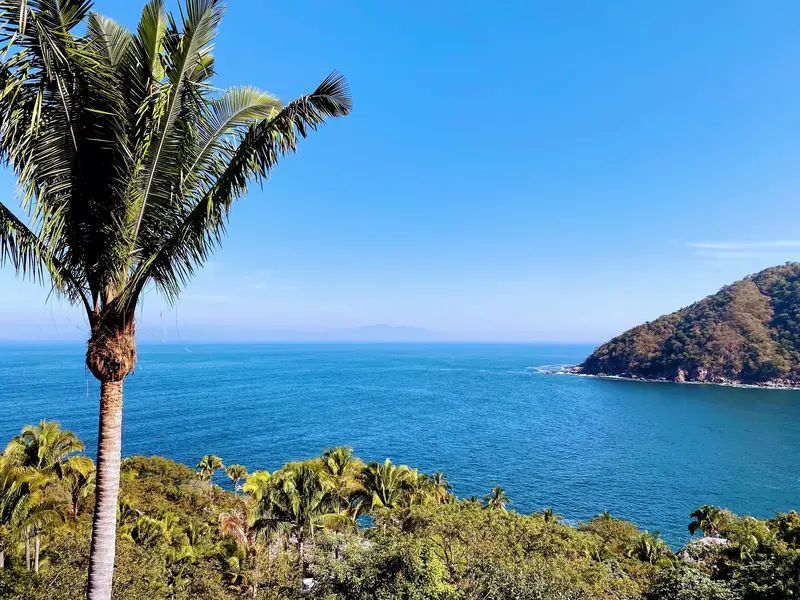
Yelapa is an easy place to watch birds: pelicans and frigatebirds work the bay, chachalacas and caciques fill the village trees, and trogons and motmots sit quietly along the river and the waterfall trail. Winter is the richest season, when migrants from the north join the year-round residents, but there's something to see in every month.
iNaturalist observers have logged 112 bird species inside Yelapa's town boundary, about 150 within 4 km of the village, and 286 across the municipality of Cabo Corrientes. The tables below group the birds you're most likely to meet by where they live. Type a word in the search box to filter them all at once.
Which birds will you see on the beach and over the bay?
Watch the water from the beach, the pier, or the terrace. Herons and shorebirds feed at the river mouth and on the rocks at each end of the beach.
| English | Spanish | Scientific | What it looks like and sounds like | Where and when |
|---|---|---|---|---|
| Brown pelican | Pelícano café | Pelecanus occidentalis | Big gray-brown bird with a pouched bill that plunges headfirst into the sea. Mostly silent. | Over the bay in lines skimming the waves, all year |
| Magnificent frigatebird | Fragata magnífica | Fregata magnificens | Black seabird with long angled wings and a forked tail; floats high without flapping. | Overhead almost any day, often trailing pelicans and fishing boats, all year |
| Blue-footed booby | Bobo de patas azules | Sula nebouxii | Brown-and-white seabird with bright sky-blue feet; dives straight down for fish. | Offshore rocks and open water; most often seen from a boat near Los Arcos, all year |
| Brown booby | Bobo café | Sula leucogaster | Chocolate-brown seabird with a clean white belly; skims low over the waves before it dives. | Offshore and around rocky islets, all year |
| Neotropic cormorant | Cormorán neotropical | Nannopterum brasilianum | Slim black diving bird with a hooked bill; perches with its wings spread to dry. Low grunts. | River mouth and pier pilings, all year |
| Heermann's gull | Gaviota plomiza | Larus heermanni | Smoky-gray gull with a bright red bill and, in breeding season, a white head. Nasal calls. | Beach and bay, November to July; most common February to May |
| Laughing gull | Gaviota reidora | Leucophaeus atricilla | Gray-backed gull with a black hood in summer and a loud "ha-ha-ha" call. | Beach and river mouth, mostly January to August |
| Royal tern | Charrán real | Thalasseus maximus | Large white tern with an orange bill and a shaggy black crest; harsh "keer" call. | Over the surf and resting on the sand, mostly November to April |
| Snowy egret | Garza nívea | Egretta thula | Small white heron with a black bill, black legs, and bright yellow feet. | River mouth and rocks at the beach ends, all year |
| Great egret | Garza blanca | Ardea alba | Tall all-white heron with a yellow bill; stalks slowly through the shallows. | River mouth, all year; most October to April |
| Great blue heron | Garza morena | Ardea herodias | Very tall blue-gray heron with a dagger bill; deep croak when it flies off. | River mouth and rocky shore, mostly October to April |
| Little blue heron | Garza azul | Egretta caerulea | Medium heron; adults slate blue, young birds all white. | River edges, mostly November to May |
| Yellow-crowned night-heron | Garza nocturna corona clara | Nyctanassa violacea | Stocky gray heron with a bold black-and-white face that hunts crabs on the rocks. Squawks. | Rocks at both ends of the beach and the river mouth, often at dusk, all year |
| Green heron | Garcita verde | Butorides virescens | Small hunched heron with a chestnut neck and dark green back; sharp "skeow." | Shady riverbanks, all year |
| White ibis | Ibis blanco | Eudocimus albus | White wader with a long down-curved red-orange bill; probes the mud in small flocks. | River mud and wet ground, all year |
| Spotted sandpiper | Playero alzacolita | Actitis macularius | Small brown shorebird that bobs its tail nonstop; thin "peet-weet" call. | River rocks and the edge of the beach, August to April |
| Black-necked stilt | Monjita americana | Himantopus mexicanus | Black-and-white wader on very long pink legs; yelps "kek-kek" when disturbed. | Shallow water near the river mouth, September to April |
Which birds live around the village and gardens?
Many of these come to the trees and flowers around Casa Gratitud, so morning coffee on the terrace is a fine way to start.
| English | Spanish | Scientific | What it looks like and sounds like | Where and when |
|---|---|---|---|---|
| Great-tailed grackle | Zanate mayor | Quiscalus mexicanus | Glossy black male with a long keel-shaped tail and yellow eyes; whistles, clacks, and squeaks. | Beach palapas and village paths, all year |
| Great kiskadee | Luis bienteveo | Pitangus sulphuratus | Bright yellow belly and a bold black-and-white striped head; shouts "kis-ka-dee." | Wires, gardens, and the river edge, all year |
| Tropical kingbird | Tirano pirirí | Tyrannus melancholicus | Gray head, olive back, and yellow belly; darts out from wires after insects. High twittering trill. | Wires and treetops around the village, all year |
| Golden-cheeked woodpecker | Carpintero enmascarado | Melanerpes chrysogenys | Zebra-barred back and golden cheeks, with a red crown on males; loud rolling chatter. Found only in Mexico. | Palms and garden trees all over the village, all year |
| Cinnamon hummingbird | Colibrí canelo | Amazilia rutila | Medium hummingbird with cinnamon underparts and a red bill; buzzy chips at flowers. | Garden flowers and hibiscus, all year |
| Rufous-backed robin | Mirlo dorso canela | Turdus rufopalliatus | Thrush with a gray head and rusty back that sings rich, robin-like phrases. Found only in Mexico. | Lawns, fruiting trees, and shady gardens, all year; sings most March to July |
| Inca dove | Tortolita cola larga | Columbina inca | Small gray dove that looks scaly; repeats a soft two-note coo. | Paths and yards, all year |
| Groove-billed ani | Garrapatero pijuy | Crotophaga sulcirostris | Shaggy all-black bird with a thick ridged bill and a floppy tail; noisy groups call "tee-ho." | Brushy edges at the outskirts of the village, all year |
| Streak-backed oriole | Calandria dorso rayado | Icterus pustulatus | Flame-orange oriole with a black throat and streaked back; whistles and chatters. | Flowering garden trees, all year; most December to April |
| Yellow-winged cacique | Cacique mexicano | Cassiculus melanicterus | Black with a spiky crest and bright yellow wing patches and tail sides; loud gurgles. Weaves long hanging nests. | Village trees and palms, all year; one of the most logged birds in Yelapa |
| San Blas jay | Chara de San Blas | Cyanocorax sanblasianus | Black and deep-blue jay with yellow eyes that roams in noisy family groups. Found only in Mexico. | Village edges and forest trails, all year |
| Vermilion flycatcher | Papamoscas cardenalito | Pyrocephalus rubinus | Male brilliant red with a dark brown mask and back; perches low on fences. | Open yards and fences, mostly November to March |
| Orange-fronted parakeet | Perico frente naranja | Eupsittula canicularis | Small green parrot with an orange forehead; fast, screeching flocks. | Logged across Cabo Corrientes; watch for flocks flying over, all year |
Which birds live in the forest and along the river?
Walk the river and the waterfall trails early, then stand still for a few minutes. Trogons and motmots sit quietly and are easy to miss until they move.
| English | Spanish | Scientific | What it looks like and sounds like | Where and when |
|---|---|---|---|---|
| West Mexican chachalaca | Chachalaca pálida | Ortalis poliocephala | Large brown long-tailed bird whose groups shout a raucous "cha-cha-lac" at dawn. Found only in Mexico. | Hillside trees above the village and the waterfall trail, all year; the most logged bird in Yelapa |
| Elegant trogon | Coa elegante | Trogon elegans | Male shiny green with a rose-red belly and a coppery tail; hoarse "kowm" calls. | Shady forest along the river and the waterfall trail, all year |
| Citreoline trogon | Coa citrina | Trogon citreolus | Yellow belly, dark gray chest, and pale yellow eyes; sits still and gives accelerating clucks. Found only in Mexico. | Forest edges and big trees near the village, all year |
| Russet-crowned motmot | Momoto corona café | Momotus mexicanus | Green with a rusty crown, a black mask, and a racket-tipped tail that swings like a pendulum; soft hoots. | Shady trails and river forest, all year |
| Lineated woodpecker | Carpintero lineado | Dryocopus lineatus | Large black woodpecker with a red crest and white neck stripes; loud laughing calls and drumming. | Big trees on the hillsides and by the river, all year |
| Pale-billed woodpecker | Carpintero pico plateado | Campephilus guatemalensis | Big black-and-white woodpecker with an all-red head and a pale bill; loud double knock. | Mature forest along the trails, all year |
| Masked tityra | Titira puerquito | Tityra semifasciata | Pale gray-white bird with black wings and a bare red face; odd, piglike grunts. | Treetops at forest edges and in the village, all year |
| Black-throated magpie-jay | Urraca hermosa cara negra | Calocitta colliei | Blue-and-white jay with a curly crest and a tail longer than its body; noisy and varied calls. Found only in Mexico. | Forest edges, the river, and hillside gardens, all year |
| Squirrel cuckoo | Cuclillo canelo | Piaya mexicana | Long rufous bird with a very long tail that hops along branches like a squirrel. | Vine tangles along the trails, all year |
| Crested guan | Pava cojolita | Penelope purpurascens | Turkey-sized dark bird with a red throat wattle; honks and rattles its wings at dawn. | Forested hills above the river, early morning, all year |
| Sulphur-bellied flycatcher | Papamoscas rayado común | Myiodynastes luteiventris | Streaky brown-and-yellow flycatcher with a dark mask; squeaky calls high in the trees. | Treetops near the river, April to September |
| Sinaloa wren | Saltapared sinaloense | Thryophilus sinaloa | Brown wren with a streaked face and barred tail; loud, rich songs from thickets. Found only in Mexico. | Thickets along trails and garden edges, all year |
| Mexican hermit | Colibrí ermitaño mexicano | Phaethornis mexicanus | Brown hummingbird with a long curved bill and a long white-tipped tail; zips along shady trails. Found only in Mexico. | Shady waterfall and river trails, mostly May to September |
| Yellow grosbeak | Picogordo amarillo | Pheucticus chrysopeplus | Big yellow bird with a heavy dark bill and black-and-white wings; rich whistled song. | Forest edges and hillside trees, all year; most November to March |
| Orange-breasted bunting | Colorín pecho naranja | Passerina leclancherii | Small; males turquoise-green above and orange-yellow below, with a sweet warbling song. Found only in Mexico. | Brushy edges and trail clearings, all year; most December to April |
| Cinnamon-bellied saltator | Saltador gris | Saltator grandis | Gray bird with a white eyebrow and a cinnamon belly; sweet whistled phrases. | Forest edges and overgrown gardens, all year |
| Golden-crowned emerald | Esmeralda occidental | Cynanthus auriceps | Tiny glittering green hummingbird with a forked tail; males have a red bill. Found only in Mexico. | Flowering shrubs at forest edges, all year |
| Green kingfisher | Martín pescador verde | Chloroceryle americana | Small dark-green kingfisher with a white collar that flies low over the water, ticking. | Río Yelapa and its pools, all year |
| Military macaw | Guacamaya verde | Ara militaris | Large green macaw with a red forehead and blue flight feathers; loud, harsh squawks, usually in pairs. | Logged in the hills of Cabo Corrientes; listen for pairs flying over, all year |
| Lilac-crowned amazon | Loro corona lila | Amazona finschi | Green parrot with a maroon forehead and a lilac crown; loud screeches at dawn and dusk. Found only in Mexico. | Forests of Cabo Corrientes, most records December to April |
| Blue mockingbird | Mulato azul | Melanotis caerulescens | Dark blue bird with a black mask and red eyes that skulks in thickets and sings varied phrases. Found only in Mexico. | Dense thickets along trails, all year; most December to April |
Which raptors and night birds live in Yelapa?
Look up at midday for soaring vultures and hawks, and listen after dark for owls.
| English | Spanish | Scientific | What it looks like and sounds like | Where and when |
|---|---|---|---|---|
| Black vulture | Zopilote común | Coragyps atratus | Black with white wingtip patches and a bare gray head; flaps quickly, then glides. | Soaring over the village and beach, all year |
| Turkey vulture | Zopilote aura | Cathartes aura | Brownish-black with a red head; holds two-toned wings in a shallow V and tilts in flight. | Over the hills and coastline, all year |
| Osprey | Águila pescadora | Pandion haliaetus | Brown-and-white fish hawk with a dark eye stripe; hovers, then plunges feet first. Whistled calls. | Over the bay and river mouth, mostly August to March |
| Gray hawk | Aguililla gris | Buteo plagiatus | Medium hawk, finely barred gray below, with a black-and-white banded tail; whistled scream. | Forest edges and the river, all year |
| Common black hawk | Aguililla negra menor | Buteogallus anthracinus | Broad-winged black hawk with one bold white tail band that hunts crabs along the shore. | River mouth and rocky shore, most records October to May |
| Collared forest-falcon | Halcón selvático de collar | Micrastur semitorquatus | Long-tailed forest falcon with short wings; loud, mournful "ow" calls at dawn and dusk. | Heard more than seen, from the forested hills, all year |
| Ferruginous pygmy-owl | Tecolote bajeño | Glaucidium brasilianum | Tiny rusty-brown owl that's active by day and gives long runs of piping toots; small birds mob it. | Village trees and forest edges, day or night, all year |
| Mottled owl | Búho café | Strix virgata | Medium brown owl with dark eyes and no ear tufts; deep hoots at night. | Forest near the river after dark, all year |
| Colima pygmy-owl | Tecolote colimense | Glaucidium palmarum | Tiny gray-brown owl with a steady series of soft toots. Found only in Mexico. | Dry forest in Cabo Corrientes, all year |
Which birds are found only in Mexico?
Western Mexico is rich in birds that live nowhere else. iNaturalist flags 30 Mexico-only bird species in Cabo Corrientes records, and more than a dozen have been logged in Yelapa itself, including the West Mexican chachalaca, golden-cheeked woodpecker, San Blas jay, black-throated magpie-jay, citreoline trogon, rufous-backed robin, and Sinaloa wren. Search "only in Mexico" in the box above to list them.
A few birds on this page are protected under Mexico's official list of species at risk (NOM-059), including the military macaw and lilac-crowned amazon (endangered) and the crested guan and Colima pygmy-owl (threatened), according to CONABIO's 2019 bird list. Enjoy them from a distance, and never buy a wild parrot or macaw.
When do the migrants come and go?
Most birds in Yelapa live here all year. Migrants add variety from late summer through spring.
| Season | What to look for |
|---|---|
| All year | Pelicans, frigatebirds, chachalacas, caciques, woodpeckers, trogons, motmots, egrets, and vultures |
| August to April | Shorebirds such as the spotted sandpiper arrive first, in August and September |
| October to April | Osprey, vermilion flycatcher, and northern songbirds and hummingbirds join the residents; most are gone by April |
| November to July | Heermann's gulls, most common from February to May |
| April to September | Sulphur-bellied flycatchers arrive for the summer; Mexican hermits are easiest to find from May to September |
iNaturalist records are heaviest from January to March, when the most visitors are out with cameras, so the dry winter months are both the busiest and the best documented time for birds here. For weather month by month, see our best time to visit Yelapa guide.
When and where is the best bird watching in Yelapa?
- Early morning. The first two to three hours after sunrise bring the chachalaca chorus, trogons, motmots, jays, and parrots flying out from their roosts.
- Late afternoon. In the last hour or two before sunset, parrots head back to roost and herons gather at the river mouth.
- Midday. Seabirds stay busy over the bay, and vultures and hawks ride the warm air over the hills.
- After dark. Listen for owls from the terrace.
Good places to start are the main beach and the river mouth for herons and seabirds, the village paths and gardens for woodpeckers, orioles, and caciques, and the river and waterfall trails for trogons, motmots, and hummingbirds. eBird keeps public checklists for Playa Yelapa and the Yelapa waterfall trail, handy for seeing what other birders have found recently.
Boobies rarely come close to Yelapa's beach. Watch for them on the boat ride: the water taxi from Puerto Vallarta runs along the south shore of the bay past Los Arcos, a marine park where iNaturalist observers often log blue-footed boobies, pelicans, and frigatebirds. For routes and times, see go2yelapa transport. For a private boat to go looking for seabirds, ask our host family in your WhatsApp group; they quote and arrange it.
How do you watch birds respectfully in Yelapa?
- Give birds space. Back off if a bird stops feeding, calls in alarm, or flies away, and keep boats well away from seabirds resting on rocks.
- Skip the playback. Playing recorded calls stresses birds, especially in the spring and summer nesting season.
- Don't feed wild birds, and never touch a nest.
- Stay on the paths. Yards and gardens in the village are people's homes, so ask before you step in for a closer look.
- Leave the drone at home near nesting and roosting birds.
- Share what you see. Logging your sightings on eBird or iNaturalist helps scientists track Yelapa's birds, and a free sound ID app such as Merlin Bird ID helps put a name to a call.
FAQ
What is the best month for bird watching in Yelapa?
December to March is a fine choice: migrants are here, the weather is dry, and the residents are active. Summer brings its own birds, like the sulphur-bellied flycatcher, and the jungle is at its greenest.
What is the loud bird that calls at dawn?
That's almost certainly the West Mexican chachalaca, a big brown bird that calls "cha-cha-lac" in noisy groups. It's found only in Mexico and is the most logged bird in Yelapa on iNaturalist.
Can you see blue-footed boobies from Yelapa?
Not often from the beach. You have a better chance from the boat on the way in, near Los Arcos, where iNaturalist observers log them in every month.
Are there parrots in Yelapa?
Yes. Orange-fronted parakeets fly over in fast, noisy flocks, and military macaws and lilac-crowned amazons live in the forests of Cabo Corrientes. All three are protected in Mexico.
What should I bring for bird watching?
Binoculars, a hat, water, and repellent for the trails. A field guide or a free bird ID app helps, and the Defenders of Wildlife bird guide for Puerto Vallarta, listed in the sources below, covers most of the birds here.
Checked October 15, 2026. Bird counts come from iNaturalist and grow as people add sightings, so confirm with the sources below before you go.
Sources
- iNaturalist, bird observations in Yelapa, Jalisco and in Cabo Corrientes
- iNaturalist, bird observations at Los Arcos marine park
- Defenders of Wildlife and Teyeliz, Birds of Puerto Vallarta identification guide (PDF)
- CONABIO, Aves de México: updated list of species and common names, 2019 (PDF)
- eBird, Playa Yelapa hotspot and Sendero Cascada Yelapa hotspot
For mammals, reptiles, sea life, and bugs, see our animals and bugs of Yelapa guide. More in our Yelapa visitor guide.
Plan your stay
Casa Gratitud's terraces look over the bay and the jungle, so the frigatebirds, caciques, and chachalacas come to you. See the house at yelapacasagratitud.com, or check rates and availability for your dates.